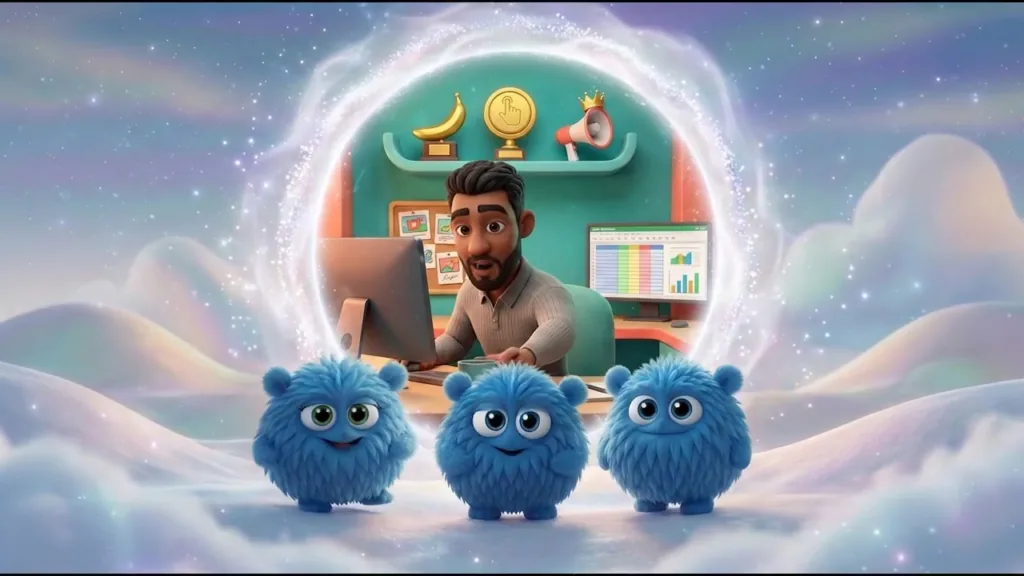
I make a series of animated videos called the Floofies, where small, furry characters bring concepts from large language models and generative AI to life. I started these about a year ago to experiment with video generation: how well video models understand physics, follow direction, preserve character identity and maintain a coherent world across scenes.
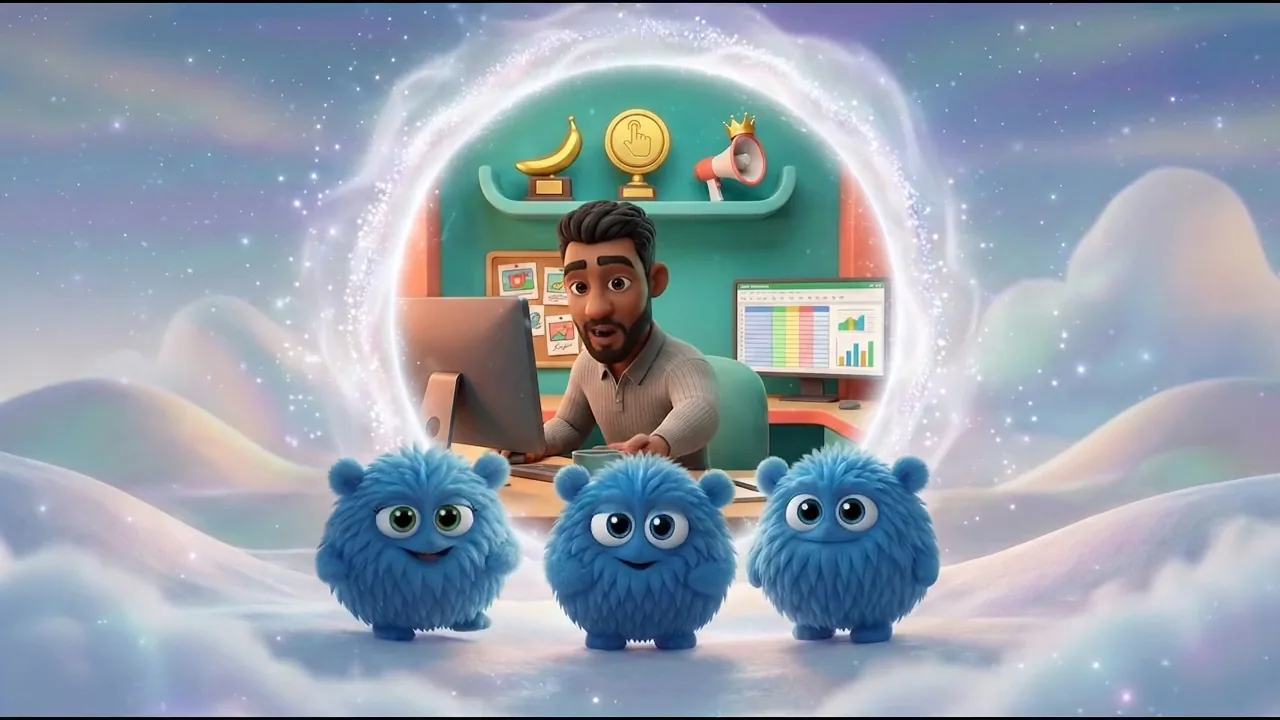
I had taken a break from the series. Video models kept improving, but not in the way these episodes need.
Codex and its growing ability to operate a computer reliably prompted me (pun intended) to try again and explore how much of this rather labor-intensive process it could take on. I expected help with preparing images, prompting video models and organizing takes. The biggest surprise came when I made a mistake halfway through an episode.
Where video models improved, and where they didn't
Video models have improved over the past six months, but not in the place my episodes depend on: holding an invented character steady, both within a clip and across the clips of an episode. The progress went into audio, resolution, pricing and editing tools. None of that keeps the Floofies round and on their side of the portal for a full eight-second generation, let alone from one scene to the next.
Pricing shaped my own choice of model. A Floofies episode takes a lot of generations, so I work in Veo 3.1 Lite, which costs no credits on Google's Ultra subscription. Gemini Omni, Google's newer video model, isn't meaningfully better for what I do. It wouldn't solve the consistency problem, and it would cost far more at the volume an episode needs. Grok is better at maintaining consistency, but its ability to handle a cast of characters performing different, uncoordinated actions is limited.
The way models are measured reinforces this. Video leaderboards rank single clips, and blind votes reward whichever clip looks best on its own. Nothing measures whether a run of clips, cut together, holds up as a story.
A universe with rules
The Floofies inhabit a universe with rules, a universe whose elements map to concepts from large language models and generative AI. They represent the parameters of a large language model: what it learned in training and what produces each word of its answer.
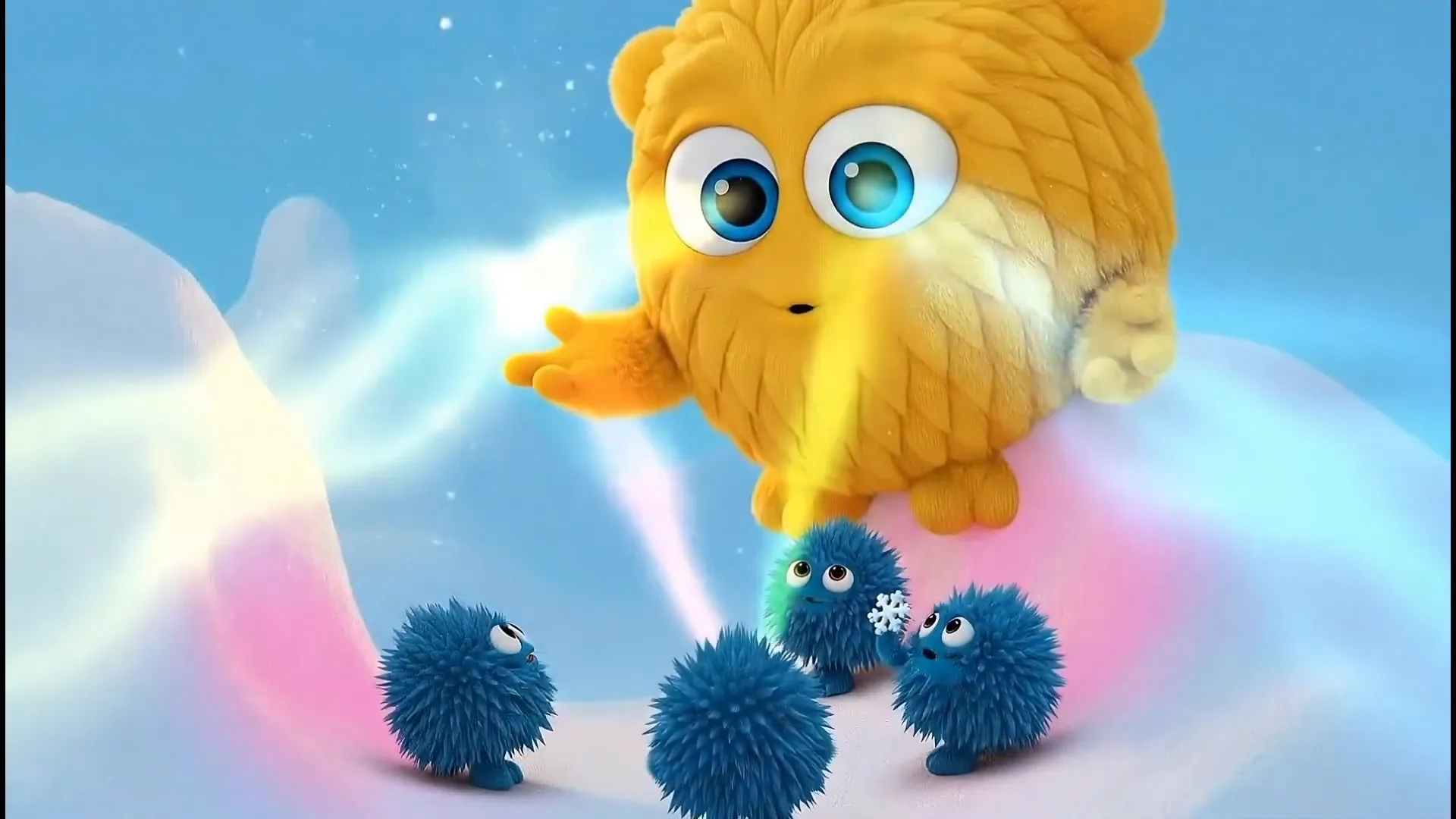
They live in a snowy landscape that represents the latent space and communicate with humans through a portal. The edges of the portal tokenize human speech. The Floofies then perform forward passes, generating their responses token by token and sending them back through the portal to the humans.
Their bodies carry meaning too. Untrained Floofies are spiky: their values start out random, full of sharp edges. Training wears the spikes down, step by step, as the Floofies learn to predict better, until they settle into round, smooth forms.
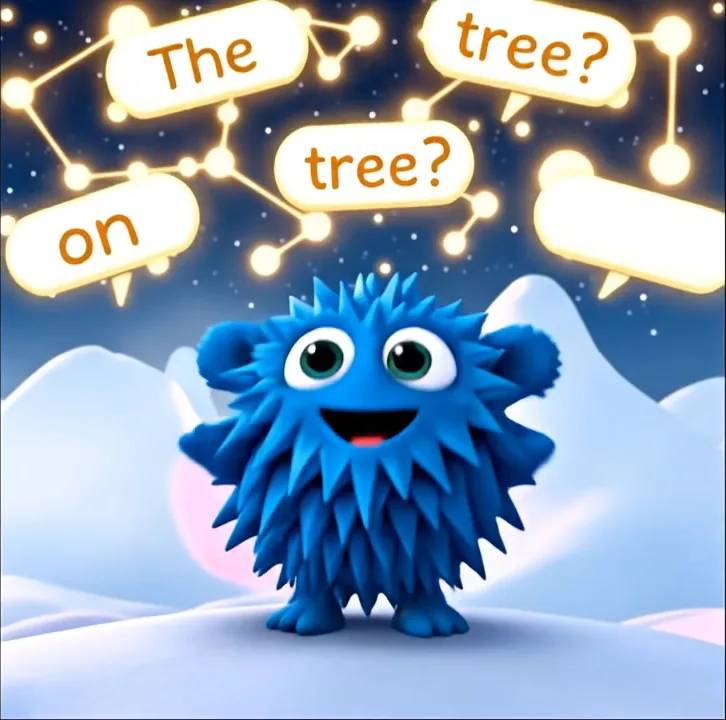

The Great Training - full episode.
Humans stay on their side of the portal; Floofies stay on theirs.
That framework gives abstract concepts a physical form. It also imposes constraints on every story. An action can be visually entertaining and still make no sense within the universe. Every character, object, interaction and plot development has to fit both the story and the conceptual mapping. The snowy landscape, the portal and the Floofies' behavior all carry meaning.
Production therefore begins with a script that has to work on two levels: as a story someone might enjoy watching and as a coherent expression of the underlying framework.
Those rules need to survive every generated shot.
From script to generated sequences
Production starts with a script, checked against the conceptual framework of the universe and divided into scenes with dialogue and direction. Each scene then needs reference images, a starting frame, sometimes an ending frame, and a prompt describing the performance.
The episodes are assembled from short generated sequences, generally eight seconds long. For this production, I used Veo 3.1 Lite in Google Flow and Grok Imagine, with eight-second generations in both, as longer sequences tend to drift.
About six months ago, after seven episodes and a lot of trial and error, I had developed a reasonably efficient process with Claude for writing scripts, checking their logic and dividing them into scenes. Prompting and generating the footage remained largely manual. I had a repeatable prompt template, but maintaining continuity still took considerable work. A scene could require tens of iterations because the model gave the Floofies rabbit ears, added another character, stretched their bodies or let them cross the portal into the human world.
Teaching Codex the production process
With Codex, I wanted to see how much of that work I could delegate.
As we produced and reviewed takes, I asked it to capture the successful methods in a reusable skill: instructions covering references, prompting, continuity, review and corrections.
The useful detail went well beyond "keep the characters round." The instructions distinguished the original character reference, which defined identity, from the previous shot's final frame, which defined continuity. They preserved successful prompts and recorded narrow changes instead of rewriting everything each time. They separated what the model could invent, such as expressions, comic timing and gestures, from what had to remain consistent.
Codex prepared scene images using Flow's image editor and, later in the production, its built-in OpenAI image-generation tool. It extracted the actual final frames from selected clips and used them alongside the original references to prepare the next scene's starting image. Where useful, it also prepared an intended ending frame.
It then loaded references and prompts into the generation tools, generated alternatives and brought the results back for me to review.
There were still rejected takes and repeated revisions. The clearest improvement was the amount of manual work that moved out of my hands. Preparing continuity images, transferring references, entering prompts, retrieving footage and organizing review became part of one connected process.
Then I discovered the mistake.
The number I got wrong
The episode followed Marcus, a marketing engineer, whose newly built dashboard showed conflicting ROI figures: 417% on Overview and 517% on Campaign. The discrepancy came from different revenue sources. Overview used a CRM export; Campaign used GA4.
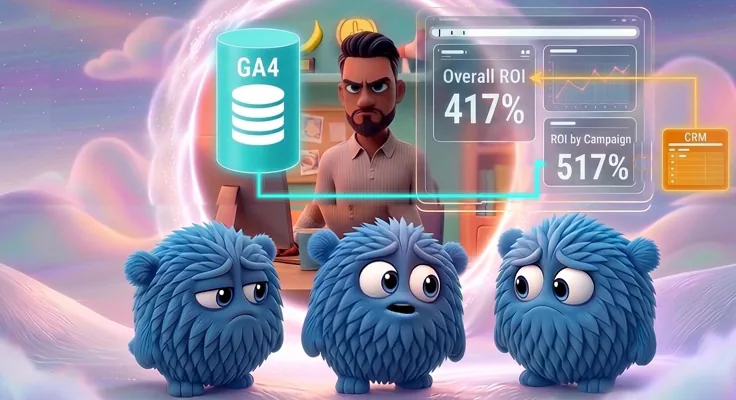
The story depended on the Floofies correcting the inconsistency by using the CRM figure. Campaign therefore needed to change from 517% to 417%.
In some of the later scenes, I had swapped the sources: GA4 was presented as the 417% figure, and the correction moved the dashboard toward 517% instead of away from it.
This affected more than a spoken number. The dashboard values, source labels and connecting arrows all had to tell the same story.
Normally, I would have gone back through the affected scenes, rebuilt starting and ending images, regenerated the footage and checked the continuity again. Every replacement would introduce another chance for the characters or the environment to drift.
So I decided to YOLO it.
I told Codex that CRM was 417%, GA4 was 517%, and it needed to fix the affected tags and beats, then continue with 417% as the corrected value.
In my head, that meant regeneration. I wanted to see whether the production method we had developed was repeatable enough for Codex to handle the changes itself: identify all the affected sequences, find the corresponding prompts and correct those scenes.
I expected to come back to a queue of fresh takes waiting for review: corrected starting frames, re-entered prompts, new generations in Flow and Grok, and the usual round of checking them for drift.
Codex went to work, and I went to make tea. About forty minutes later, Codex was still working, but no new scenes were being generated. I interrupted it and asked where they were.
Its answer was not what I expected. Codex hadn't been generating anything. It had decided the footage we already had was worth keeping, and for forty minutes it had been editing the downloaded clips directly, correcting the numbers, labels and arrows in place rather than asking the video models for new takes.
How Codex repaired the footage
It used FFmpeg and scripted image compositing to repair the existing shots.
The numbers were baked into the generated dashboard imagery. They weren't editable text layers in a video project. Codex constructed corrected image patches and used masks to control where those patches appeared over the moving footage.
In the fix-and-celebration shot, it restored Overview ROI to 417% throughout. At 1.9 seconds, it changed Campaign from 517% to 417% in place. For that change, it extracted a matching "4" from the existing artwork and replaced the first digit, keeping the original "17%" and the surrounding label.
It also corrected the connections: CRM fed the appropriate cards, and GA4 was disconnected from them after the fix.
The clip continued playing forward. The Floofies performed the same celebration, with the same timing and audio. No new video generation was needed for that repair.
There were limits.
An old connector crossed Marcus's face. To conceal it, the edit used a clean still patch that held his head in place after the fix, sacrificing some of his original movement. In another repaired shot, holding the Floofies in a closed-mouth pose also held their movement. These were visible production tradeoffs that needed review.
I asked for a synchronized comparison of the original and edited footage. The durations matched, and the extracted audio was byte-for-byte identical.
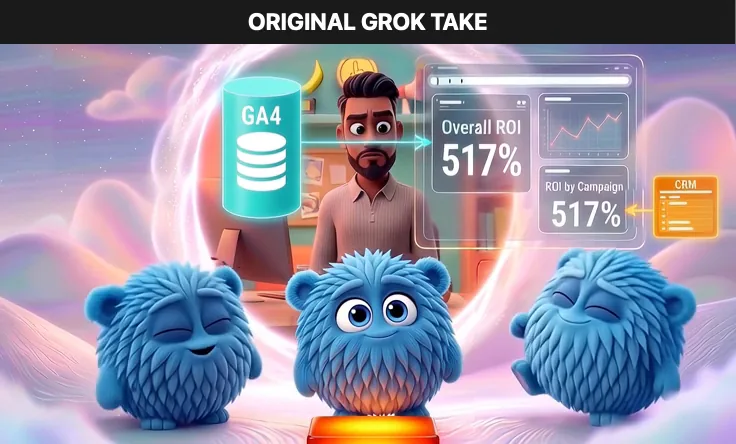
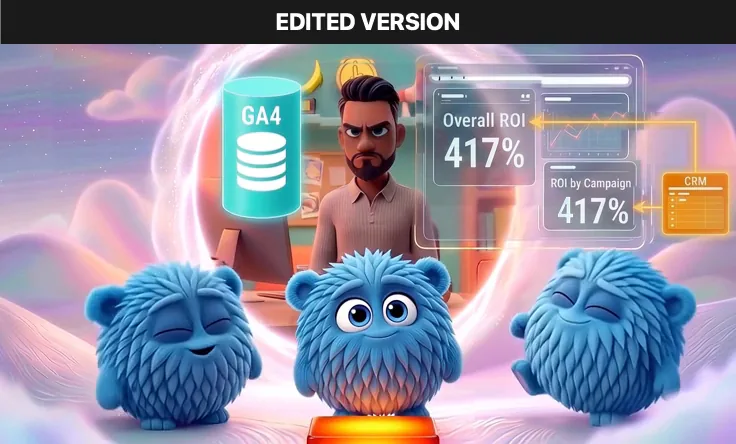
I watched the comparison twice, then called off the regeneration. Codex would fix the rest of the scenes the same way.
The repaired beats then went into the assembled ROI cut.
The communication could have been better. Codex's updates mentioned correcting graphics and preserving accepted acting, but they hadn't made clear to me that it was editing existing exports and that I should expect no new Grok posts. Next time, I would want an explicit explanation of the proposed method and its tradeoffs before that work began.
Where the value moves
I expected Codex to repeat a production process. It found a different way to solve the problem. It connected the story's meaning to the visual assets, identified the changes required and brought editing tools into a workflow I had been thinking about only in terms of generation.
The weights belong to Google and xAI, and anyone can rent them. What made this episode work was everything else: the references, the continuity rules, the checks, the skill and the agent's choice of tools. That part is mine. It carries over to the next episode and improves every time I use it. As generation gets cheaper, the part you own is where the value accumulates.
The labs have noticed where the value is going, and they are building that layer into their own systems. That is the idea behind world models. A video model renders a fixed clip from a prompt, and once generation starts, you can't steer it. A world model generates frame by frame, remembers what is in the scene, and responds to actions while it runs.
Google's Genie 4, announced on October 27, is a clear example. It relies on Gemini Omni for how things look, while a separate Gemini model plans the scene's steps and checks each new frame. It has the same structure as my production: Codex planned and checked, while Veo 3.1 Lite in Flow and Grok Imagine rendered.
That still doesn't solve my problem. By Google's own account, visual details and object permanence still drift over time.
And there is a difference that matters more than drift. In Genie 4, Google owns the planner. In my production, the planner worked from my references, my rules and my skill. Both point to the same shift: the value is moving away from the system that generates and toward the system that directs and checks it. The open question is who will own that system.
The repair also says something about the tools themselves: don't fix something with a probabilistic tool if you can fix it with a deterministic one. Generating a new performance requires invention. Replacing a known digit at a known time can be specified exactly. Once the necessary footage and repair assets existed, masks, coordinates and timing gave us direct control over the correction.
The same principle applies in analytics. If a wrong result can be corrected with a known SQL expression, there is little reason to ask an LLM to generate the entire answer again and risk changing other parts of it.
Generation is getting cheap. What made this episode work was everything around the generator: the skill that carried forward what we had learned, the checks on every take, and the judgment to repair footage instead of generating it again. The next improvement in making these videos may come from a better video model. More likely, it will come from the system that directs it.
That is also why, after all of this, I rewrote the episode. The ROI story was about fixing a number. The new one, We Made a New App by Lunch. What It Needed to Survive Monday Was Another Story, is about the work around it. Marcus wants to stop chasing his agencies by email, so he plans a simple app: a chat window and an upload button for each agency, and one place to ask questions across all of them. Building that much is easy now. Then the Floofies eagerly list everything it needs to run for real: storage, search, access control, versioning, failure recovery, monitoring and an audit trail. The prototype was the easy part. Production is most of the work.
That production layer is what we are building for analytics at Ask-Y with Prism. It directs and checks the model, working from the customer's own data model and metric definitions, and it provides connected data, a memory engine, classification, security, access controls and review tools. Teams build their apps on that foundation instead of commissioning it from scratch, and the part where the value accumulates belongs to the team that uses it.