Chapters
00:00 Understanding the New Data Layer Paradigm
02:35 The Importance of Website Health
05:43 Real-World Examples of AI Integration
08:51 Balancing Human and AI Needs
11:30 Technical Foundations for AI Readability
14:50 The Role of Accessibility in AI Optimization
17:45 Vibe Coding vs. Traditional Development
20:37 Evaluating AI-Powered Tools and Red Flags
24:40 Evaluating AI Tools Effectively
27:48 Understanding AI Models and Their Applications
30:15 The Security Risks of AI Systems
34:22 Measuring AI Agent Performance
36:11 Transitioning from Attention to Utility Metrics
40:23 Preparing for the Future of Analytics
44:24 Navigating AI Fatigue
48:04 Focusing on Key Metrics in E-commerce Analytics
Transcript
Katrin Ribant (00:01)
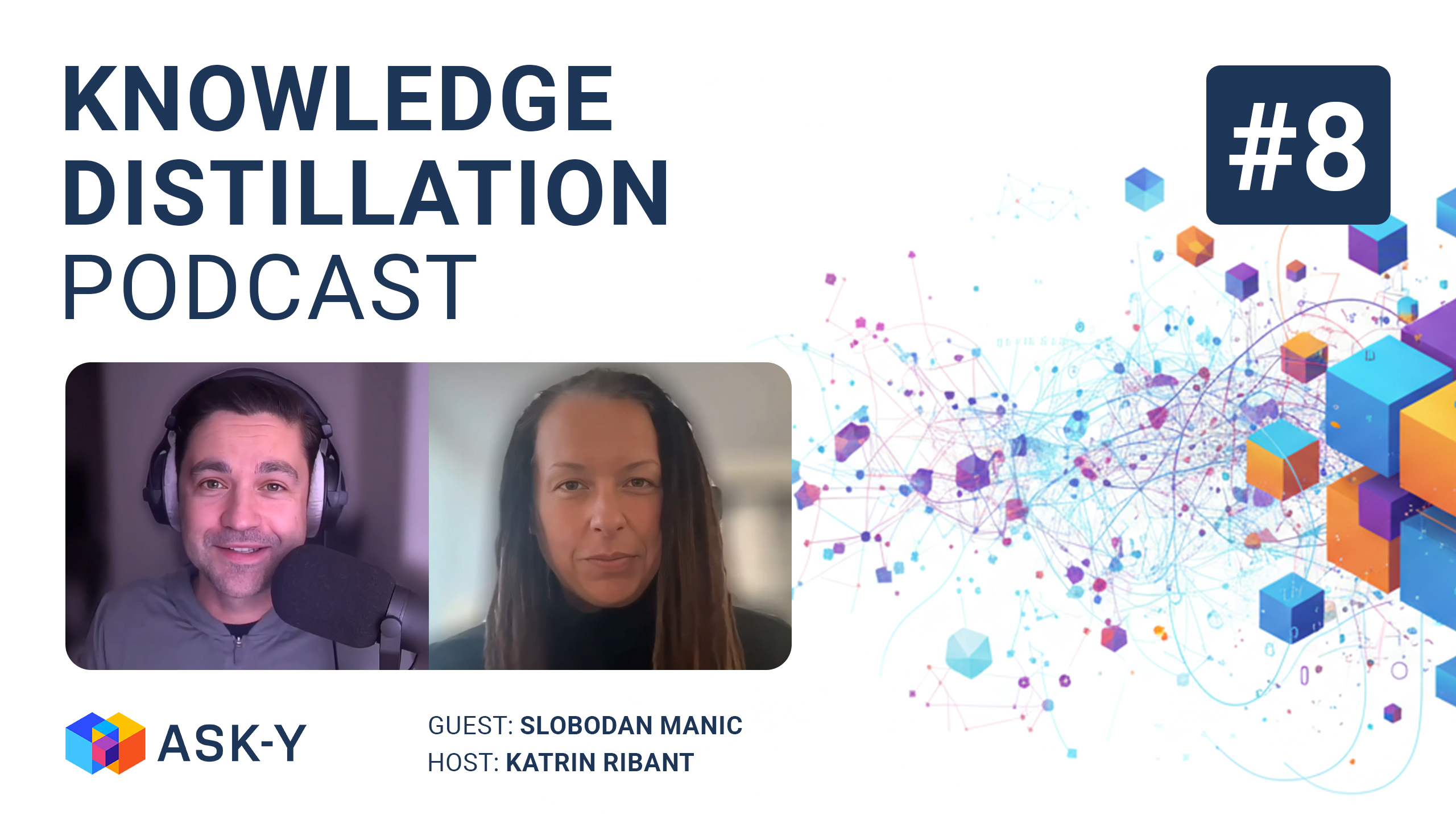
Welcome to Knowledge Distillation where we explore the rise of the AI analyst. I'm your host, Katrin Ribant, CEO and founder of Ask-Y. This is episode eight and today we're tackling a shift that's reshaping e-commerce and the web at large. Our websites must now satisfy two audiences, humans and AI agents. For this, my guest today is Slobodan Manic, though everybody calls you Sani. Sani, you're a website optimization consultant with 15 plus years of web performance, CRO, and technical SEO. You work with teams at Instacart.
You also wrote for Search Engine Journal and certainly did a whole bunch of things that my research hasn't yet unearthed. You're also a WordPress core contributor and obviously you host the NoHacks podcast, which I think has 200 plus episodes at this point. Now subtitled, Optimizing the Web for AI Agents. Is that correct?
Sani (00:46)
That is correct. First of all, what a wonderful intro and thank you for having me. It's an honor to be a guest on the podcast.
Katrin Ribant (01:09)
Well, let's thank Claude for the help. Not that I didn't know some of these things and I can read LinkedIn, but Claude was really helpful. We're dead. We're dead.
Sani (01:12)
No, this is great. Come on, we had multiple conversations already before we even talked about the recording. So thank you, Claude. Let's say that.
Katrin Ribant (01:23)
So, all of this tells us exactly where your focus has landed and why you're my guest on this episode. Would you tell us a little bit about how and why you decided to focus on this?
Sani (01:26)
So I, like many people, fell into the trap of needing to know everything about AI as soon as it's out. We've been living the hamster wheel life for the last two or three years. Everything is the most important thing in the world. Everything is right around the corner. Some big things are happening. It's going to be amazing. I'm tired of that. Honestly, I spent the second half of last year just being tired of trying to keep up with everything.
Maybe it's ADHD and the need to know and explore everything. Most optimizers have something. I just got tired. And I noticed that every new update and release is kind of the same as the old one. GPT-5, was that even a new model? Was that just a label on the old model? I think it doesn't matter. Most things happening in the AI world don't matter.
I think the ratio is 99 percent hype and bullshit, 1 percent signal. If you don't know what the 1 percent is, it's best to sit it out and wait to see what's actually worth paying attention to. At the same time, we have 35 years of web infrastructure, all the websites we've built over the last 35 years. Now we have AI that needs to look at them and understand them. And who's doing that work? That feels urgent, necessary, and extremely important. More important than keeping up with the latest models. So I'm going back to what I know how to do best: optimize websites and make them technically healthy.
Katrin Ribant (03:14)
So tell us what you were specializing in before this shift, when it comes to web optimization. I know you're very specialized in one specific aspect, and how that leads into this.
Sani (03:18)
When I started learning about web development back in the mid-2000s, the first decade of the century, when we were still dealing with IE6 and IE7, I was dead focused on semantics, accessibility, and learning what code actually means.
At that time the browser needed everything to be perfect to understand it. Then I moved into technical optimization, speed optimization, Core Web Vitals. I did some analytics briefly and technical SEO. The thing that always sticks is that you need a healthy website, whether that's for humans, people with accessibility needs, or AI agents and LLM systems.
Getting the basics right is the most important thing before CRO or SEO or anything else. If the website is healthy, everyone benefits. That's why I'm going back to this. It feels like more people are abandoning websites and building vibe-coded things while nobody is shaving two seconds off page load. Why are people not doing that?
Katrin Ribant (05:19)
Right. That definitely changes the experience. And speaking of which, we collaborated recently on something really fun, the Halloween episode of the Floofies. For those who don't know, the Floofies are AI-created characters I use to explain how LLMs work.
Katrin Ribant (05:43)
Things like context windows, attention mechanisms, token generation. The episode is called The Floofies and the Instant Checkout Crisis. It's a parable about brands becoming ghosts when their data isn't optimized for AI discovery. So what does this look like in the real world?
Sani (06:21)
The real examples are being released right now. OpenAI has a shopping agent. Perplexity has something similar. Users won't need to visit your website anymore. They'll ask an AI assistant to find a product, the agent identifies candidate sites, completes the transaction, and the user never sees your brand, your copy, your design.
We're moving the threshold up. We're not optimizing product pages for emotion anymore. We're optimizing for clarity. We need to make sure AI systems understand exactly why they should do business with you on behalf of the human.
Katrin Ribant (07:15)
But humans still visit websites, and we still need SEO. How do you balance those two?
Sani (07:41)
You find what humans and machines have in common and optimize for that. Semantic code, speed, accessibility, clarity. Humans need fast websites. Google has been telling us this for years. Core Web Vitals, EEAT, expertise. All of that quietly prepared us for the AI age. Those things matter more now than ever.
Katrin Ribant (09:03)
You're focused on technical foundations. How do those translate to AI readability?
Sani (09:42)
Make your website as complicated as it needs to be and nothing more. Trim the fat. AI processing costs tokens. That won't be free forever. Most websites are slow because they load assets they don't need. Unused JavaScript, CSS, third-party scripts. Trim that and you're ahead of 95 percent of sites.
Katrin Ribant (10:51)
Can you give a concrete example?
Sani (10:54)
Take front-end A/B testing scripts. People load them on every page even if the test only applies to one page. To prevent flicker, they block rendering and add two seconds to every page load. That's catastrophic. You're also relying on third-party CDNs. If they go down, your site goes down.
Only load assets when you actually need them.
Katrin Ribant (13:34)
What are common failures you see specifically for AI agents?
Sani (14:01)
Accessibility. If you use a span styled like a button instead of a real button element, it looks fine to you but not to assistive tech or AI agents. Use correct HTML. Make it painfully obvious what every element does. If you don't, AI will guess. And guessing leads to hallucinations.
Katrin Ribant (15:31)
So paradoxically, to work with a guessing engine, we need to be extremely precise.
Sani (15:45)
Exactly. It needs help. Messy HTML leads to a messy accessibility tree, which agents rely on. That increases failure rates.
Katrin Ribant (17:17)
This also creates a cleaner data layer for analysts.
Sani (17:17)
Yes. We know the solution. Fix the road instead of building bridges. HTML is the language of the browser. Specs haven't changed much in years. But now everything is bundled into JavaScript. HTML used to be meaning, CSS decoration, JS interactivity. That separation still makes sense.
Katrin Ribant (20:10)
Do you see brands trying to fix this with vibe coding?
Sani (20:19)
Yes, and it doesn't work. Vibe coding is typing prompts without understanding the problem. If you don't know what correct looks like, AI can't fix it for you. Long-term it's cheaper to understand the fundamentals or hire someone who does.
Katrin Ribant (24:32)
What red flags should people look for in AI-powered tools?
Sani (24:40)
If the builder has never done the task without AI, walk away. They don't know if the output is correct. Second, test consistency. If the tool gives different answers each time, that's a red flag.
Katrin Ribant (27:48)
Where should people invest their learning time?
Sani (28:15)
Learn the basics of how LLMs work. System prompts, token prediction, probabilities. You don't need a PhD. A weekend of reading is enough. Otherwise people take AI output as truth without questioning it.
Katrin Ribant (30:15)
Let's talk security.
Sani (30:21)
The exposure risk is huge. Cloud-based LLMs should not be trusted with sensitive data. Even if companies say they don't train on it, they can't fully control it. The attack surface is enormous.
Katrin Ribant (34:22)
How do analysts measure AI agent traffic today?
Sani (34:22)
It's nearly impossible. Look at server logs. Behavior patterns. Fast navigation is likely an agent. We're in the pre-Semrush era for agent analytics.
Katrin Ribant (36:11)
How should KPIs change?
Sani (36:11)
Move from attention to utility. Completion rate matters more than time on page. Did the agent complete the task efficiently?
Katrin Ribant (40:23)
Do you think GA4 can evolve to handle this?
Sani (40:23)
Probably. If there's one tool that will be broadly adopted, it's Google Analytics. Why create a new tool when they can extend GA?
Katrin Ribant (44:24)
Let's talk AI fatigue.
Sani (44:24)
Most of it doesn't matter. Follow monthly summaries. Ignore the noise. Focus on fundamentals and doing your job well. Don't chase five percent productivity gains at the cost of sanity.
Katrin Ribant (48:04)
One final piece of advice for analysts?
Sani (48:04)
Pick the three most important things and focus on just those for a week. Ignore everything else. See what happens.
Katrin Ribant (49:03)
Where can people find you?
Sani (49:16)
The NoHacks podcast, nohacks.substack.com, and my personal site.
Katrin Ribant (50:18)
If today's conversation made you think about how AI is changing data analytics, visit us at ask-y.ai and try Prism, our platform helping analysts navigate complexity with context. Thanks for listening, and remember: bots don't think, AI analysts do.