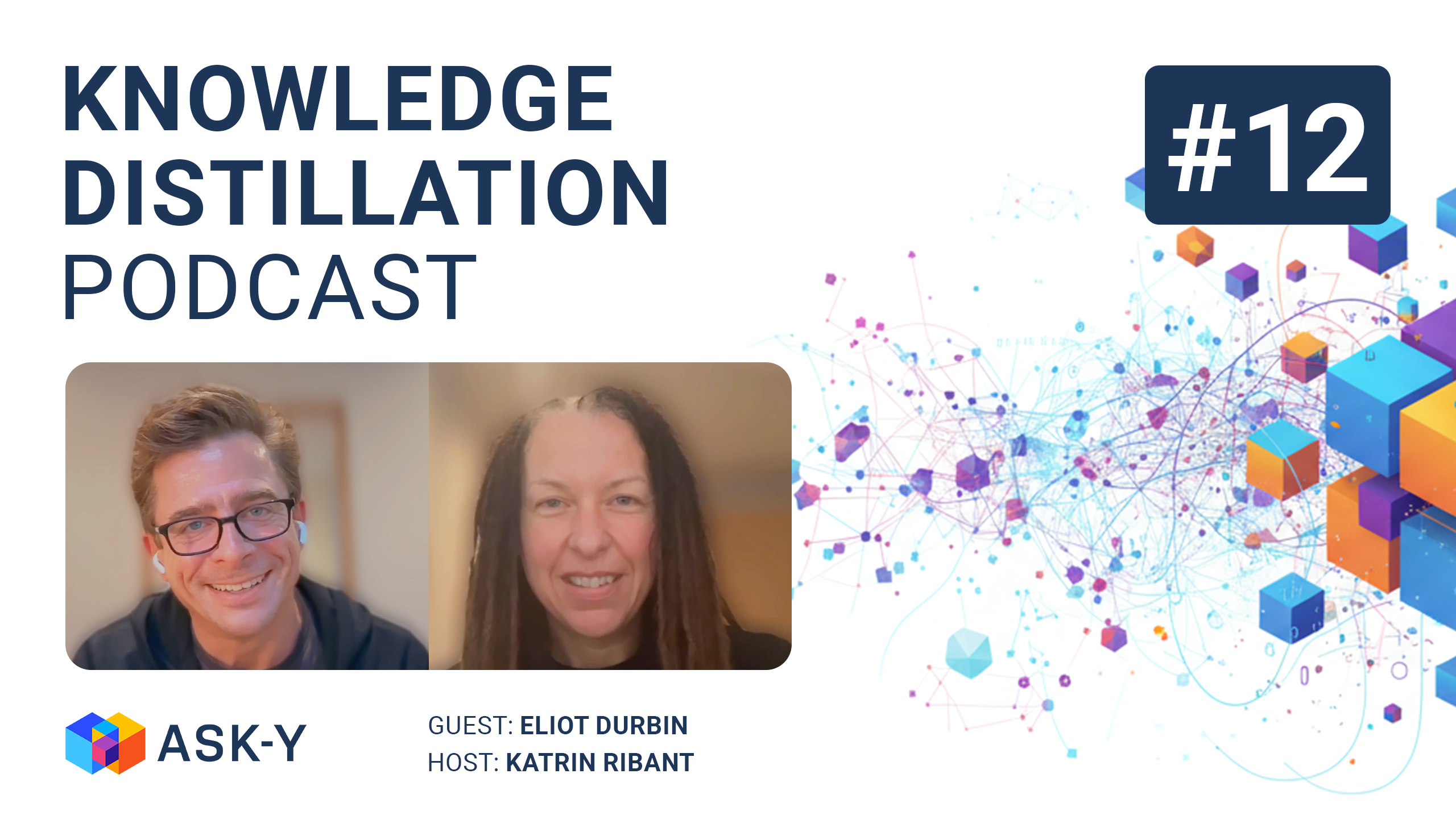
Katrin (00:01)
Welcome to Knowledge Distillation, where we explore the rise of the AI analyst. I'm your host, Katrin Ribant, CEO and founder of Ask-Y. This is episode 12. And we're interrupting our series about agent e-commerce to take a step back and look at how AI is changing the digital analytics industry. If you're in analytics, you have seen a number of AI-based tools and platforms crop up to solve for different aspects of the digital analytics workflow. Today,
We're talking to someone who funds technology development from inception and we'll learn about what that is. Eliot Durbin is a general partner at Bold Start Venture. Eliot, we've known each other, I want to say 15 years
we know each other from your ⁓ early days at Boltstart and my early... Yes, we were. Yeah, totally.
Eliot (00:49)
Well, we were roommates. We were roommates, right? We
were all trying to find an office we could use and none of us could afford a full office, but you could at that point and you were kind enough to sublease it to us.
Katrin (00:56)
Yeah, definitely not.
Well, I was going to say we could only because we were subleasing.
Eliot (01:05)
⁓ okay, so this guy does win-win.
Katrin (01:07)
Yeah, totally. So yeah, your early days at Boldstart, my early days at Datorama and you backed our Squire from inception. Thank you for that. So that's before we even had a pitch deck, before we, before I even had any pitch really. So please tell us about yourself, Boldstart and investing from inception.
Eliot (01:21)
Thank you for allowing us to.
Well, first, thanks for having me. It's exciting to be here. As you know, a big fan of the community that you're building. ⁓ So Boldstart ⁓ met Ed, my partner, Ed Sim, in 2009, and we got Boldstart going in April of 2010. First fund was a million dollars, believe it or not, in 2010. And we had a very simple thesis, which was bring, you know, at the time it was a West Coast view.
of investing in people that had strong product opinions and were technical, but didn't yet have a product or at the time it was spreadsheets and analysis ⁓ based on a business. My career has been about tuning my filter for people and founders that want to solve the problem.
Katrin (02:24)
Can I interrupt you
for one second? Because you said your first one, I kind of want people to understand that not all VCs were born, you know, with enormous amounts of money in their pockets. this is something that you you built from. So what are the economics?
Eliot (02:40)
It's a deceptive business
in that it pulls you in and by the time you realize how difficult it is, you're pretty much unemployable doing anything else. So it's a burn the boats type of career at a certain point.
Katrin (02:55)
I actually, that's right. I never thought about it that way. But like a million dollar fund, you can't make a living, right? On that. If you could like explain maybe, if you don't mind explaining the economics of it to people, just so people understand how much conviction it takes to start a fund and to build something that, know, and then we'll kind of go into where you are today and what you built over the course of 17 years. ⁓ Can you like explain that a bit?
Eliot (03:22)
When we started, was, were trying to, number one, if we could have raised more money, I think we would have. ⁓ My partner, Ed, is a little older than me, and I think he blamed a lot of this on me, because the management fees that you get off of a million dollars is not really enough to get an office or buy a cup of coffee or whatever it is, but it was a beta test. So we were really trying to embody what we were looking for in what we were doing ourselves, dog fooding, if you will.
Katrin (03:51)
So basically, it's like building a startup.
Eliot (03:52)
and
In some ways, it takes a little bit longer and the economics and the way the business succeeds is a little different when you go into that, but it was a beta test and we invested in 11 companies. And what's most interesting about that first fund, it was so focused. was $100,000 checks, $75,000 checks into, it was probably a million to a million and a half dollar rounds and it was called SEED back then.
Katrin (03:58)
Mm-hmm.
Eliot (04:25)
It's still called, see now it's a little different, but really what it was is the institutionalized super angel from the decade before. And the job is very simple. It's invest first in the person and then help them with options on everything from next round financing to hiring to first customers, things like that, to get more leverage for the next round of financing so that you can own more of your company and get a higher valuation.
introduce multiple ⁓ competitive bids for next round and you can increase the price. That's what I first saw when I saw a great angel investor do this 17, 20 years ago. I saw them giving leverage to founders at that very first layer so that they could build their company faster ⁓ and own more of it at the end of the day is really what it is. But it's basing a decision on
a person and their level of focus, their unique opinion, their, in a lot of cases, they're pitching a new market that doesn't exist yet. So a lot of it is really, you know, looking for the person standing on the beach with binoculars saying, hey, there's a big wave coming. And, you know, most people kind of sit there and look at them and say, you're blocking my son or, or whatever it is, you know, and we tune into those people.
And I think there's just a certain set of subtle signals that you can look for and really dig into to have a meeting of the minds with a founder and partner with them. Because that's what it is. It's not investing. It's partnering up. It's taking the risk with them versus measuring the risk ⁓ after the fact. So it's.
Katrin (06:17)
And you guys
are really, really active in helping your founders, right? I think probably from
Eliot (06:23)
Sometimes,
sometimes, sometimes we, you know, it's equally as important to leave founders alone sometimes. I always like to say that I don't think any business truly at its core ever succeeded because of its investors, but I know plenty that have failed because of the investors. And I think that there's this balance that you need to strike at different phases of the company. So know when to challenge and to, you know,
Katrin (06:30)
Mm. Yeah.
Eliot (06:52)
really be active versus when to lay back and just let things play out and let founders iterate in their own heads.
Katrin (07:01)
That's interesting because when you said that you cannot create it, but you can destroy it, right? ⁓ I actually think that it's very much like hiring in a way. That's always what I think about when I hire somebody is person has a motivation, opinions, ⁓ a drive. This is not something that you can create. This is something that comes with whoever you hire.
Eliot (07:06)
It's debatable. It's like, you know, it's Thursday. I might have a different opinion tomorrow, depending on the day.
Katrin (07:31)
But if you mismanage it, you can destroy it. And I suppose that's true, right? It's true also for working with your founders. You want to make sure that you help them with the leverage and let them run.
Eliot (07:35)
Great point.
Absolutely. ⁓ I'm trying to, was thinking of a ⁓ part of the filter I look for that I developed and have just been relearning in different ways over the years. But I always ask myself, am I going to be keeping up with this founder or is this founder going to be keeping up with me? And what I look for is clearly the first one. ⁓ Because if you're keeping up with your investors, I'm not so sure there's inherent value.
Katrin (07:49)
Yeah.
Eliot (08:17)
Because moving fast is the only advantage you have in the beginning with focus. And if it's done right, it takes some energy and enthusiasm to really keep up with and eventually get ahead of. That's always the practice, as they say. My career practice is being ahead of the founder with the right thing at the right time when they need it. And if I can do that, that's the good day in art.
Katrin (08:46)
And so talking about big waves and seeing big waves, we're in a big wave now, at least for the past week, 10 days, it's been a really big wave. ⁓ Let's talk about the...
Eliot (08:58)
All the best surfers I know have been on planes
flying to the wave with their boards intact. Yes, I think it's a very big wave.
Katrin (09:05)
So let's talk about
the SaaS apocalypse or SaaS-Mageddon that has vaporized over a trillion dollars in software market cap since late 2025, 300 billion in a single day after Cloud Co-Work launched with the plugins. So let me ask you, is software dead?
Eliot (09:28)
I've heard different views on this. I don't think software is dead. think that there are, you know, we're both in San Francisco right now. And the last time...
Katrin (09:38)
We're actually both in your house
right now. Thank you for having us.
Eliot (09:43)
Well, thanks for being here. ⁓ But the last time there were two hyperscalers in San Francisco was, what, early 2000s? Right when Google was coming public and then Facebook launched. That was literally the last time there were companies growing this quickly, I think, ⁓ in San Francisco. And I think that creates a certain level of gravity. It's just physics. And you start to see talent
⁓ clustering again here, you start to see a ⁓ lot of derivative startups, know, everybody doing kind of the same thing, everybody's doing now context engineering, everyone's doing observability, and you start to see the same layers of the enterprise stack forming. You know, have monitoring, have tracing, have, you know, basically all the rails that an enterprise would need to use software. We saw this with the cloud. We saw this with EC2 when it came out.
and it makes things more efficient. ⁓ So the wave is here and it will have all of the same qualities. I remember, ⁓ you know, the mobile revolution back, know, 2010 ish, right around when we started, there were three companies per box, category box. And you wanted to make sure that you had a landing and an exit before your direct competition did. It was like a game of musical chairs.
so to speak, and when the music stops, you needed a chair to sit down. That happens in a big wave, and ⁓ we'll use the bubble word, but I think bubbles are cycles, and why we're in cycles, there's tons of reasons, like I'm not smart enough to know, but I do recognize the same patterns, having done this a while, and I think the main pattern I see is the most irrational founders are gonna win, because they'll have the greatest set of, they'll have the greatest focus. ⁓
and they will be able to move the fastest to do one thing really well. And I think that that is what you can control as a founder in this type of market. So is software dead? No. It could be, but I don't think so. I'm betting all the chips on the table are that, for me, it's not. It is simply evolving, and that is a tumultuous, ⁓ sometimes vigorous process.
in changing and I can, but the difference this time though, unlike the cloud is that you have this top down interest. You know, the CEO of a fortune 500 says, I want to be, uh, it's not even AI native anymore. It's a gentic. Right. And you then have thousands of employees running around.
Katrin (12:21)
Yeah.
Yes.
Eliot (12:34)
saying, okay, we need AI, we need a Gentic, okay, let's go. then there's this huge top-down pressure to adopt it. And so we're seeing all the trappings of that. We see, okay, well, it's being adopted, but these agents are non-deterministic and we can't get them to repeat the same thing over and over. Okay, well, that's where the startup ecosystem really ⁓ is necessary. Because in that case, there's gonna be a thousand different ways to eval your...
agentic system and we're still seeing that play out right now. Which method is correct? Right? What's the best practice for handling these things? I was talking to somebody last night at this meetup about, we have this company Keycard. Keycard is assigning identity and doing access control. So, you know, identity and access management for agent to agent on behalf of humans. That's a new dimension of software that we haven't seen in security.
So it has to be thought through and the best way to do that is in this lab where there's opinions on how to do that. And as a venture capitalist, I don't really self-identify that way, but that is our industry. ⁓ It is, I think, almost Darwinian, but it's the way that we will evolve software. So I don't think it's going away. I think it's simply evolving and it's happening faster and faster.
Katrin (14:03)
And so we've seen this big wave of lack of confidence in or sort of drop in value in the large, large cap software companies, right? Over the past 10 days. And you invest in software, but you obviously invest in software at the other end of that. Like what's your thinking, know, incumbents versus startups? ⁓
Eliot (14:26)
It's interesting. That's a great question. our fastest growing company right now, it's called Clay. Clay, when GPT-3 came out, was, I think at the time, four or five years old. And they were right in what I call the Goldilocks zone as a SaaS company. And if you're not familiar with Clay, as a technology, is a spreadsheet.
interface, but it has this tremendous power to it because each cell is an endpoint for an API. And they can pull in all these disparate data sources and enrich leads fundamentally and a lot more now, but that's fundamentally what it did. But then the agents came in and what Clay did was they created the Claygit. And there were all these agents that would go out and scrape
your customers, prospective customers' websites for all these signals. And that is what BDRs did manually, like five years ago. They would sit there and they would prospect and they would put all this data in a spreadsheet. Even like company like Salesforce did this, you have to enter stuff in a spreadsheet. So if you think about the amount of software that is underutilized today, it is becoming less because of AI agents. It is simply a way to populate the software
with a lot more data to get a much better output. And that's what Clay harnessed. And when they did that, it was so clear that their product was better than anything in the market. And they took off. So I think that you can harness this as an existing company. I think there are probably great examples of companies that are like ServiceNow or even Workday that have adopted this early and worked it into their products ⁓ at a big scale. And yeah, there's going to be...
hiccups and a bumpy road along the way to adopt these things. But I think what everyone realizes is if you don't have this embedded in your software, it's equivalent to not being in the cloud or not being a mobile native version of it. So I think that there's this new, ⁓ it's evolution, it's evolution of software. So do I think that the companies that have not adopted it as quickly, are they gonna go away? Yes.
⁓ And it's unfortunate. And I think, you know, we see all of the full spectrum at bold start. think ⁓ I remember when I finally had my GPT moment, the first thing that Ed and I both did was immediately start running into the portfolio going, is everyone seeing this? Is everyone got this? Because the speed here is super critical. And we measured it. We measured it like which portfolio companies had the quickest time to first prototype.
Katrin (16:58)
Mm-hmm.
Eliot (17:21)
two, three years ago. And there is such a high correlation with success and making it into this new ⁓ era and layer of software ⁓ with the reaction time. So it goes back to the speed. More and more, I just relearn the same lesson over and over in a thousand different ways. Speed is your only advantage in startups. Focus on speed.
Katrin (17:47)
And today it's really fast, it's become really fast, right? Really faster than before. And so your thesis is basically about compound leverage at the stage of inception, right? Not capital, it's compound leverage. So I'm thinking of this, this question really comes from a point of view of, imagine you're a data analyst and you have all these tools coming at you, new tools that promise to do this, that, et cetera. These tools are funded.
Eliot (18:01)
great way to put it.
Katrin (18:17)
by people like you. Less handsome, less smart than you, less all of these things, but more or less people like you. ⁓
Eliot (18:24)
you're so good. Okay, thank you.
Katrin (18:34)
Today, we are in a situation where pretty much anybody with decent domain knowledge can vibe code a decent version of an application in about a week. In a world like that, what does that change to compound leverage at inception? Does that change anything to the way you look at things?
Eliot (19:00)
I think that it's made what your moat is and your defensibility much more important. I think that there are going to be new ways to create moats. An example being, you know, put a human in the loop. Don't automate everything because that creates another data set that is unique. In that, I think there's, you can do a lot of things with interaction data from software as your users are using the tool.
it can get better faster. ⁓ But yeah, it also speeds up time to prototype. So you can test ideas a lot faster, right? So there's this two-sided coin in every kind of topic. if it comes to, does it change my thinking? Absolutely. ⁓ Because if you're not an AI company, you're not going to be able to achieve a venture scale valuation.
Katrin (19:37)
sure.
I kind of
want to test this theory. Yeah.
Eliot (19:59)
That's table stakes. But you can build
on that. You can build on that. say, OK, so you can get it out there. can vibe code it.
Katrin (20:05)
Mm-hmm.
Eliot (20:07)
heard someone say they were a Vibe Investing the other day. That was super fun. But here's the thing.
Katrin (20:12)
tell us
about those. Seriously, tell us about what you think about that. That's so funny.
Eliot (20:24)
I'm like, well, I want to vibe invest. That sounds great. ⁓ I think what it allows you to do is rapidly prototype things. once you do that, don't think putting a company together is still a human ⁓ endeavor. And I do think that those skills are still relevant. So I do feel a little comfortable that for a little while longer, I will still have a job.
Katrin (20:42)
Yeah. Yeah.
Mm-hmm.
Eliot (20:54)
But I think that eventually your customers that buy your software, I Gary Tan said this early on, you're actually selling an eval.
you're actually selling trust. Yeah, that was a great thing because I think, and we both saw the same thing at the earliest point, which is, okay, these AIs can automate things, but can you trust it? Because that's what customers buy, right? They buy, okay, I can trust you to give me leverage ⁓ on this thing. And so you still need to...
Katrin (21:08)
Can you explain that for the audience?
Mm-hmm. Yeah.
Eliot (21:33)
build relationships with your customers and I filter for that. Can you walk in, can I walk you into a customer that I know and incredibly get them to take a risk on trying out your software? ⁓
Katrin (21:38)
Mm. Mm.
That's
the thing in enterprise, they're taking a risk. They have to know that they can count on you.
Eliot (21:55)
it. ⁓ But I think the next part of it is going to be, okay, well, it's scaling. And I think even OpenAI had to go and hire the best scaling people who probably helped out with meta before that and Google before that. there's to scale a system and a company that quickly is an immense challenge.
Katrin (22:20)
out yet, of course.
Eliot (22:21)
And I think that that hasn't changed. The capital requirements have changed a little bit. But I think that if we look at what it takes to get going, bar is lower. If you really knock it out of the park like a cursor or a lovable, ⁓ I think that there's just new challenges that come down the pike at you.
Katrin (22:45)
So let me test this theory with you because I've been thinking about this for the past two days. Like how does it change, you know, how does, how does this change the software landscape? I'm thinking, and maybe this is wishful thinking and hope, right? But I'm thinking that what it does really is, eliminate the moat for the sort of what I call the gluttonous companies, right? The gluttonous, you know, like the, the, the thin wrappers, the, the, have a,
I have a vague idea and I'm just going to hack it together and I have no real mode actually. Well, if that's what you are, then your client, your customer can basically vibe code your application in two days and make it fit exactly their need. And on a small scale, they're not going to need you.
because they're not going to need the security, et cetera, they're not going to need all the layers that come with actually building software. And so from that perspective, I imagine it actually does change that early stage. Yeah.
Eliot (23:51)
give you another dimension, agree with you. ⁓
If we look at the way founders are planning their companies, that's changing. So I have a company, Crew AI, and Crew is early to the framework ⁓ market, and it's since become probably the most competitive space that you could be in.
Katrin (24:13)
Could you just explain what is QAI? What they do?
Eliot (24:23)
So, Crew AI started out as an open source framework and was one of the earlier ⁓ proponents of dividing a task into discrete parts so you have a crew. And if you do that, it becomes more accurate. And I think that method ⁓ really, you know, they were very early mover on that. They got a lot of adoption and they have translated that into this enterprise tool.
because they were getting inbound from a lot of enterprises. But those enterprises I learned in this journey, he was an engineer at Clearbit and then led their infrastructure. And he was one of the earlier ⁓ adopters of these automations with GPTs in a way, because he was a data scientist before that and an engineer. So he was able to enrich a lot of ⁓ things at Clearbit. And he actually educated me on what a agent was when I first met him. ⁓
But what I've learned working with him is that enterprises want to embed this into all sorts of things. So the challenge is focus because they're basically coming in saying, yep, we manage 50 global divisions and we want the employees in these divisions to be able to make automations. And a lot of them are non-technical folks. So if you think about the challenge, it's actually a UX challenge coupled with a infrastructure
It's got to work. It's got to be easy. And that is a very tried and true set of challenges, right? But if we think about it, the companies that win are the ones that focus. They move fast.
What I'm seeing is that the market itself is racing to adopt this so fast that they're now just figuring out what the challenge of that adoption is at a massive scale. I think that what crew taught me was, okay, discrete tasks. And you look at Claude Cote, we're right there. That is now, ⁓ you you're going to be selling a product, which is a skill eventually. And where does that lead us?
Katrin (26:30)
Yes.
Eliot (26:39)
I just think it leads us to better software because it's no longer walking in. Great analogy, I'm doing this off the cuff so this could be terrible or this could be, I don't know. But do remember, we're dating ourselves, but do you remember walking into Computer City or CompUSA back in the day? Like one of my favorite, I used to hang out there, I was bit of a nerdy kid, but I would go to CompUSA and I would look at all the boxes.
Katrin (26:55)
Yes.
Eliot (27:04)
all the aisles and all the shelves for like Microsoft Office 97 and all these other things. That was off the shelf software. It wasn't made for you, it was made for millions of people. And then it got distributed through physical retail stores. And if you think about that software versus today, wow has it become much more personalized. It first got personalized more over the, you know, with cloud and with mobile.
and all of the data that could be ascertained about us to make the software more useful, whether it's consumer enterprise or matter. I think that what we're entering is an era where it gets even more personal, as in probably the UX is designed on the fly eventually by an LLM for you in that moment. And that's really cool.
Katrin (27:48)
Yeah, I agree.
based
on an infrastructure that means that whatever it's, that's the thing, right?
Eliot (28:00)
The other thing that's happening is interface has changed into the point where I have portfolio companies today. I would put ask why in this bucket in a way, in another way I would not. But there is no interface.
It's going to work with your existing tools. And that is the most... I'm leaving it there. We can edit that out if you want.
Katrin (28:20)
going to not say anything. I'm not going to say anything on air on air about that for the moment. Yeah,
no, I'm going to keep that a secret still for the moment. Yeah. no, no, no, that's okay. No, that's okay. This is this is completely fine. Well, we'll keep it this way.
Eliot (28:31)
Okay, so for editing, let me restart that. So I think what's most exciting... Okay, but
the portfolio companies that don't have an interface are going in and saying, look, low cost of trying this out and adopting us because we will plug in directly to your existing tools. And we've seen early parts of like, it just works. It lights up and it solves the cold start problem.
Katrin (28:51)
Mm-hmm.
Eliot (29:00)
One of my favorite qualities of a security company called Wiz was how fast it worked. I remember when Wiz came out, I looked at it and I just tuned into how quickly you could connect it. You didn't really have to deploy it. So I've been encouraging a lot of our companies to think through how they could do that and how they can increase the speed at which their software works. And customers respond incredibly well to that.
You don't need an implementer. You don't need a team of eight people setting up the software to be ⁓ useful to you. That is the first thing that's going to compress. They call it productize your deployment.
Katrin (29:43)
nice. like that. So segue into ⁓ one of the ways that I see coming that affects our audience majorly. It's agentic commerce protocol, ⁓ anything that has to do with ⁓ GPT and commerce, all the versions of that that are cropping up at this point. You think about that, it really will kick off.
a massive amount of refactoring on the part of marketers, brands basically, because you have to make sure that your website is going to cater to humans and agents that you are seeing, et cetera, that has a certain number of requirements of how your website is structured. It's a lot of work to fix that for most, especially the bigger you are, the more complex that is, the more your website is old and a button is not called a button. And the agent, the commerce agent doesn't see JavaScript.
So all it sees is the button called the button. You're going to clean all of that up. Once you've done that, you have to recreate your data layer for data capture, because obviously all the basis has changed. Within that, you have to decide how are you going to measure this? Because all of a sudden, you don't have a person in a purchase funnel. You just have, oh, we sold something. Great.
And then how does that impact your relationship with your customers and your loyalty programs, et cetera? So this is like, I see a big wave of this coming, you know, as works for kicking off a lot of analytics related work ⁓ for basically any company that markets, which is a lot of companies. ⁓ And if I think about customer, yeah, right. One of your ⁓ sort of like large companies.
Eliot (31:33)
Yep. Well, previous and
current. And current. So Meta acquired them. Customer ⁓ Brad Birnbaum and Jeremy Surreal, ⁓ co-founders of Customer. ⁓ This is their, I think, third customer support startup over the course of a couple decades. I was joking with them the other day. said, every time there's a new database, you all come out with a new customer support startup.
Katrin (31:37)
and current. do you want to just say for the audience a word? Yeah.
Understandable.
Eliot (32:02)
So we had the ticket hierarchies, but then the graph database came out and they said, okay, we're to do it again. And we can now connect all of the customer interactions into a beautiful timeline like Facebook when the graph database came out. now, and Meta acquired them ⁓ for a billion dollars. I don't know if I'm allowed to say that, but I'll check it after this. ⁓ what's most interesting is Meta was not decided that at the end of the day, their ⁓
Katrin (32:06)
Mm-hmm.
Yeah, yeah, you're-
Eliot (32:33)
They were not intended to be in the customer support business and they divested it back to us. So we got a second lap with customer to take it even further, which you rarely get in my business. It's very exciting, but they they re-architected their entire platform and vector databases. And I think that, you know, they're seeing the benefits of that early kind of move and decision right now. ⁓
Katrin (32:37)
Mm-hmm.
Eliot (33:02)
When you think about how that affects the relationship with the customer, absolutely, you're to have more data on your customers. You're going to have an incredible amount of interactions with them that you're going to have to structure and plan for. So it affects strategy. And we're seeing that even at our other companies like Waldo. And we have a new one hasn't been announced yet. So I'm going to leave it alone just so I don't want to preempt the founder.
on any funding announcements, but it is automating the entire job of a entire marketing team for a CFO or CMO scooping and
what I mean, it's a huge market. So you're going to see a lot of the the biggest companies adopt go after that first because there's huge money to be made. So Shopify, you see that happening pretty aggressively.
Katrin (33:52)
As you mentioned, customer re-architected, the basis, the data, literally the database. ⁓
Eliot (34:00)
And apparently there's a lot
of restrictions on what AI you can use at Meta. So that really wasn't kind of jamming with them.
Katrin (34:06)
Yeah,
I can see that. Yeah, I can see why that would happen. But they're really... I can also see how that would happen. they're really... Custom really crosses like old world, new world, right? And they've done it in what I would consider the right way, which is by actually re-architecting. Because it's one thing to have your infrastructure and then put a layer of, we're agentic because we have some...
Eliot (34:10)
It did not kinder joy, you know, as he says, a little frustrating. Yeah.
Katrin (34:36)
prompts that run on data. That is what I would call gluttonous and thin layer. If you're not actually AI native from the ground up, you're stuck in the complexity of what you can end up doing with your infrastructure. So this disruption, when you think about the sort of ideas that are landing on your desk currently, do you see anything, and obviously no names, no, you know,
no specifics, but anything in the direction of ideas that are related to agent e-commerce that you find interesting.
Eliot (35:15)
A lot. I have historically not invested in a ton of commerce. We have, right? There's been great, you know, pure commerce businesses, but there's a lot of consumer elements in those businesses. So it's just full disclosure, an area that I've not been as focused on because if it touches a consumer, ⁓ bold start, that's not our core competency.
Katrin (35:22)
Mm-hmm.
Eliot (35:41)
You know, we're very focused on technical developers, enterprises, things like that. ⁓ I just, think you can do that very well. You just have to do that. So it was a choice we made. ⁓ But the most I was talking about, was talking to a CEO of a very large and growing API gateway that is powering Anthropics SDK.
Katrin (35:42)
I'm with you. don't, yeah.
Yeah, I agree.
Eliot (36:07)
He said, the greatest example is, okay, so give an agent your credit card number. Do you hesitate? A little bit.
Katrin (36:16)
More than a little bit.
Eliot (36:17)
I said,
but this is why I don't do consumer because it's really the adoption curve here will be very human driven. It'll be how comfortable are you having this agent act and transact on your behalf. Now, my guess, a 22 year old is gonna be a lot quicker to do that because when
I was 22, I pretty much dropped everything. like, well, cool. I got nothing to lose. Let's do it. I'm not used to doing it. Uber, sweet or whatever. ⁓ But I think that what it will change first, and we saw this, you remember the move from Alta Vista to Google and immediately how quickly meta tags died.
Katrin (36:50)
Yeah. Yeah. Yeah.
Yes.
Eliot (37:10)
I used to do that HTML, used to just load my websites with meta tags so that I could get indexed by those bots. But then with backlinking, that all changed and it turned into, okay, well how do I optimize? And we're seeing the same thing today with AIO, you know, kind of the AI optimization. Do you have enough markdown on your website to have it be readable? Last year that wasn't a thing.
Katrin (37:37)
I agree. That's true.
Eliot (37:38)
I remember
just asking Chad GPT things over and over and over in the hope that it would work its way into the deeper parts of the memory so that when other people searched for it, it would show like inception investing. My partner had must have asked Chad GPT a thousand times, hey, ⁓ who coined the term ⁓ inception investing? And finally it returned, ⁓ Ed Simot-Boltz star. And he goes, when? that, those are the early, ⁓
The early ⁓ qualities of what is now a year later being a full process and whole startups. There are thousands and thousands of these startups that are doing optimization for AI, and they're doing different parts of that optimization. They're doing the attribution. They're doing the content creation for those ads. They're generating websites on the fly based on where you're coming from. V0 was a great early example.
over at Versailles. They really nailed, ⁓ Jared kind of saw that coming and he built this. It wasn't a perfect tool, still isn't, but it was a great example of what's coming. And I think that the first thing you usually see is the commerce folks, because they're always tuned into changes because the margins are tight, especially on the e-commerce side. They're going to adopt as much optimization as they can without cannibalizing their business. So I think we're seeing that right now.
Katrin (38:55)
Yes.
Eliot (39:06)
with everyone's, I don't know, I'm just thinking about how many things can I just make a markdown file? Because at the end of the day, if it's more readable, I'll be able to automate it and I can move faster on everything. ⁓ We're also seeing it on the ⁓ marketing side with a lot of the agencies that do this work with brands. They're racing to adopt AI because without that, they're outmoded and irrelevant. So we're seeing...
almost like early internet. I need a website. I don't know what needs to be on it, how to market it, or how to maintain it, but I can hire someone to do it for me. So you'll see the partnership and ISV channels start growing a lot earlier than normal in a lot of ways. So service firms will have their day because you can automate, can service 10 clients instead of two with AI, but you can also do a lot more
Katrin (39:56)
I'm sure.
Eliot (40:05)
with less in terms of the client spend. So if your client spend goes down, you're gonna find a way to bring it back up.
Katrin (40:15)
Yeah. And, ⁓
Eliot (40:16)
And that's what's going
to pull this all into the bigger enterprises in my opinion.
Katrin (40:20)
And talking about so obviously this podcast is really about the rise of the AI analyst and our audience is is digital analysts mostly Which you know, the AI analyst is a role that did not exist a year ago The AI engineer existed the AI analysts really didn't because AI doesn't really work as well for data as it works for software because the Workflows are different making AI work for
data analysis is very, different than making work for a for just software generation. But you so you dated yourself so I can say that you don't you didn't date me. just dated yourself.
Eliot (41:03)
trying to keep it just real as possible.
Katrin (41:06)
Yeah!
So ⁓ you went through a few of these cycles of ⁓ new roles, And Clay, which you mentioned, Clay came up with the GTM engineer role. But you also had like Y-Hat, ⁓ Sniq, Crew AI, all of these companies, yeah, all of these companies, basically, because they saw that wave and they saw that that wave was going to change how people work.
Eliot (41:27)
Big ID, Protect AI, yep, up and down the stack.
Katrin (41:39)
point and defined a persona that didn't really technically exist before them. ⁓ Do you have an opinion about the AI analyst and what's happening now? it different? Is it? Is it? Yeah, go ahead.
Eliot (41:57)
I have an opinion. I do.
at each, I mentioned earlier that we have two hyperscalers in San Francisco here. Now, they will define the new roles, just like Google really defined what a product manager is. If you're growing that fast, you have the leverage to organize your company in the way that you think is best. In a lot of cases, I think that that results in new roles.
Katrin (42:09)
Mm-hmm.
Eliot (42:32)
And I can tell you, and this is genuinely, ⁓ this is a real story. When I asked Kareem and Nikolai in our first meeting with Clay, what do really want to do? What's your mission? And I asked founders this most of the time, just, I get the company, but like, things are going to change. What's your mission? What do you want to accomplish? And I'll never forget it. The reaction was immediate. They knew it. They said,
We want to create more programmers.
time there were 30 million and I thought that was super interesting because a football coach is a programmer they just use a clipboard and that's the most inefficient thing you know ⁓ and that's effectively what they've done with the go-to-market engineer they have allowed ⁓ a commercial salesperson or in their case specifically rev ops to program their go-to-market in ways that that include reasoning
And that I think is we're going to see transpose itself onto every function in the enterprise. And that's kind of the larger autonomous enterprise that we have. So it's just the beginning of that, right? They started with rev ops and they're going to go up and down, you know, the different functions in a company from support all the way up to revenue producing function. I think that the AI analyst is going to be in the same vein as that.
Katrin (43:43)
Mm-hmm.
Mm-hmm.
Eliot (44:04)
the analysis, the way it's, you know, where the reports go, what decisions are made based upon those reports will change. But the good news is that the tools will be so much more robust to answer those questions. So there will be a need and then it will drive the use case. So if we think about the main use cases for an AI analyst, you probably know better than anyone. What are they?
And of the total that we will have eventually, how much of that has currently been discovered? I would argue probably pretty small.
Katrin (44:44)
yes, for sure. But I think what you said about, you know, Clay and having more programmers, that is really, I'm really trying to sort of like get to root of if you're an analyst today and you know you need to upscale because you need to become an AI analyst. You need to use AI. You're not going to have a job in a year if you don't. I mean, it's surprising if you have a job today, ⁓ if you don't, but in a year you won't. So given finite amounts of focus and time,
What should you upscale in? What is the kernel of what you should actually upscale in? And what you said, in my opinion, is exactly it. Basically, you need to hone in on your quote unquote programmer skills, as in the logic of your workflow, understanding how things go from A to B to C, because natural language is now your interface. So you don't have to worry so much
about the exactitude of the syntax, et cetera. But you do need to worry about what it is you're actually doing in that analysis and the logical steps of it. And that is something that you need to like...
Eliot (45:56)
And that's a different
exercise than two years ago as an analyst. Yep, you're gonna set things up to maintain themselves. You're gonna set things up to provide context for your coworkers that are doing the same thing. And I think that we're just gonna see that abstract at a level up into reasoning. And I don't think that that means the end of an analyst. It just means a higher level of analysis.
Katrin (45:59)
very, very different.
Mm-hmm.
I think I don't think it means the end of the analyst at all.
Eliot (46:27)
But play with as many tools as you can would be my only
and best advice because that's what I'm doing. You you saw OpenClaw come out. The ease of integration there is, mean, everyone's saying, okay, I had my GPT moment and now I had my OpenClaw moment. And I can understand why. It was a really elegant integration ⁓ that resulted in almost magic in a way.
Katrin (46:35)
I agree that.
Mm-hmm.
Eliot (46:54)
But what it really highlighted was what a group of agents or a swarm could do. And I think that playing with those tools is going to give you ideas that you could not have before.
Katrin (47:07)
And that's a wonderful segue into ⁓ my last question I wanted to ask you about the sayings you have about the autonomous enterprise. ⁓ Can you just tell us about that?
Eliot (47:20)
Enterprises have been trying to, or in automating things since there were enterprises, I think. And I mean, go back to the printing press, instead of writing it out by hand, let's use, you whatever founders say, well, okay, enterprise, you know, maybe they're coming into it for the first time, whatever. said, well, there's two things you can do in an enterprise. You make the more money or you can save the money. And we're seeing that play out again in the most sophisticated way yet. So,
Katrin (47:27)
Yeah. Yeah.
Eliot (47:50)
Enterprises will say, well, if you save us money, we'll use you. Well, always caution founders to a little cautious about that when they price based upon savings. Because you can only save an enterprise so much money over time. So if you're saying I'm going to save you half your cost because I'm going to eliminate the need for half of this group inside of your company, be careful with that. Because eventually those people will be gone and you won't be able to charge anymore. So I think the other end of that coin.
is you can make people more productive, but you can also make them more money. So the best companies ⁓ that I see grow over time have the qualities of I automate things and that elevates workers with more productivity. So you think about the things that used to actually get done. Before email, there were copying machines, Xerox machines to copy paper. Think about that, it's almost like a foreign language now. Why would you copy it?
We have DocuSign. That's automation, right? ⁓ Even on the individual user level, which is where a lot of our companies start and then go enterprise. So, Sneak is a good example. They didn't want, developers ⁓ starting in Node early on did not want to get a call from security and or trace the dependent libraries based upon some vulnerability that's inside a library, that's inside a library. ⁓ So you get a phone call from security and Sneak almost had a
Katrin (48:53)
if
Eliot (49:20)
great productivity boost when they said, it gives me a tree and it just tells me where it is. Oh, cool. I'll start using it because it makes me faster. But then security noticed this and they also at the same time realized, wow, now it is kind of like Swiss cheese at the time, right? And there's a lot of security holes in it. But we would need the developers to find them for us. And security isn't really great in general at communicating with developers. So this does it automatically. So they took off.
So it's been going on for years. The autonomous enterprise now is going to be different, but it will be literally the same thing that they have always done. Be more efficient, make more money.
Katrin (50:05)
And I agree with you, you obviously have to be more efficient, but you do need to do value creation. You cannot be in the efficiency play only. It just really doesn't work. ⁓ So thank you. This was actually really, really amazing. ⁓ Just amazing conversation. Yeah, it really did. It was really fantastic.
Eliot (50:23)
Time flies. I had super fun. Hopefully it made sense.
Katrin (50:29)
Shamelessplug, do you want to tell people where to find you? We'll put the links in the show notes. You can just say whatever you want.
Eliot (50:38)
Thank you, you can find us at boldstart, B-O-L-D-S-T-A-R-T dot V-C. ⁓ And ⁓ I am on ⁓ X at ET Durbin and reach out anytime.
Katrin (50:51)
Cool, thank you. We'll put that in the show notes. So thank you, Eliot. It was amazing. And that's it for episode 12 of Knowledge Distillation. If today's conversation made you want to experiment with AI for analytics, visit us at askwhy.ai and try Prism. Thanks for listening. And remember, thoughts won't win. AI analysts will.
Eliot (50:55)
Thank you very much for having me.